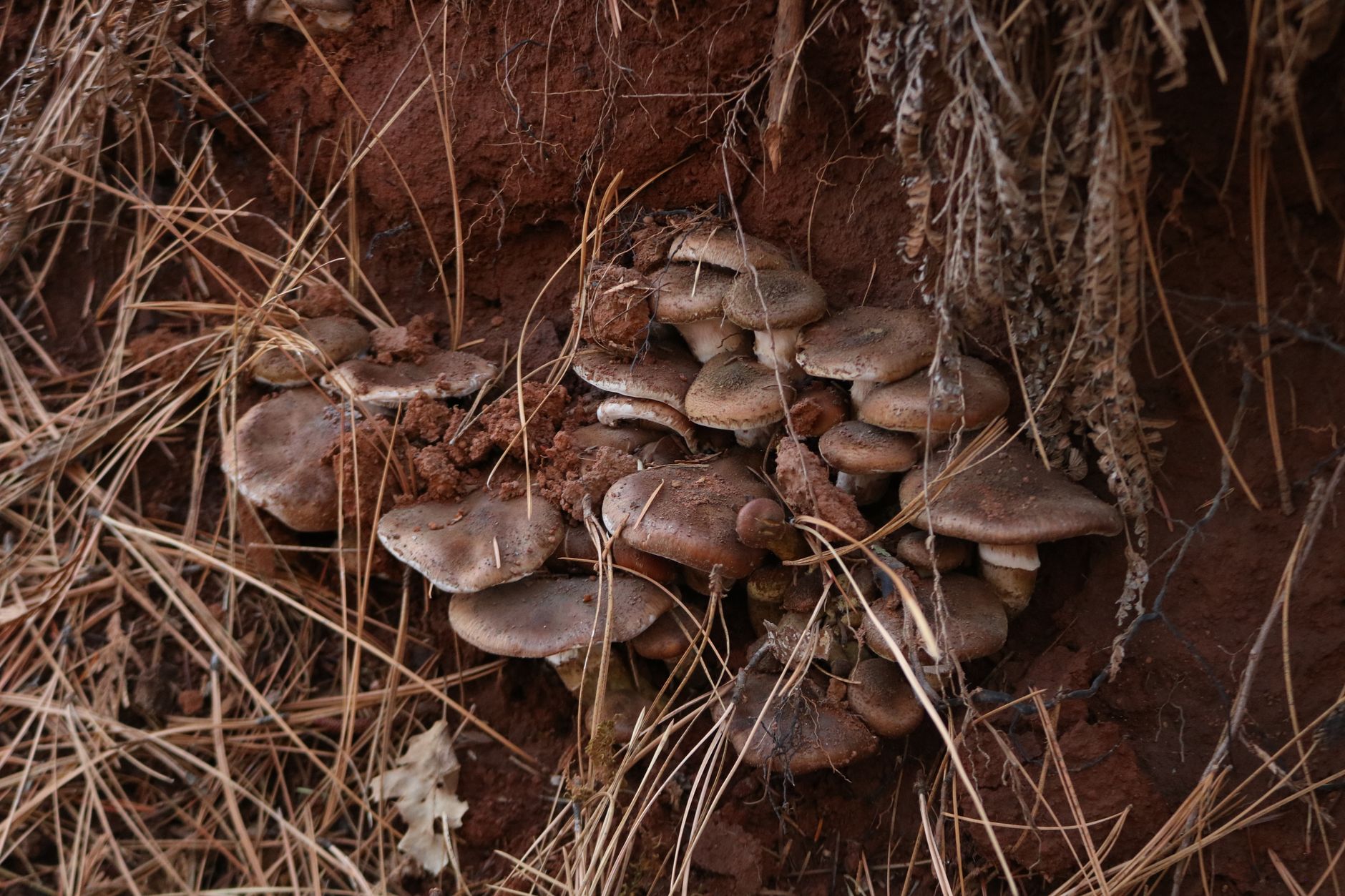
Beneath your feet right now, spreading through soil in every direction, lies something so vast it makes blue whales look microscopic. A global network of fungal threads so enormous that if you stretched them into a single line, it would reach beyond Pluto—past Neptune, past the entire solar system, and keep going for a billion times farther. Scientists just mapped it for the first time, and what they found is reshaping how we understand life on Earth.
These aren't sci-fi organisms. They're arbuscular mycorrhizal fungi—threadlike networks that have been quietly doing the most important job on the planet for hundreds of millions of years. The networks wrap around plant roots in an intimate partnership: the fungi deliver phosphorus and nitrogen that plants desperately need, and in return, plants feed the fungi carbon they've pulled from the atmosphere. The math is staggering. These underground webs are currently locking away 1 billion tons of carbon annually—carbon that would otherwise be warming our atmosphere. Without them, our climate crisis would be exponentially worse.
What's wild is that despite their obvious importance, nobody really knew how massive these networks actually were until now. A team at SPUN (Society for the Protection of Underground Networks) spent years combining soil samples from around the globe, machine learning analysis, and decades of research to create the first comprehensive map. The numbers are almost incomprehensible: 110 quadrillion kilometers of fungal threads. That's connecting roughly 80 percent of all plant species on Earth. "This is the moment where we went from knowing that this system exists to really knowing where it is, how dense it is and where it's been," said Toby Kiers, the executive director who helped lead the research.
Here's what matters for you: these networks are disappearing in the places we farm. Industrial agriculture—with its heavy tilling, pesticides, and monocultures—is decimating fungal communities that took millennia to develop. Meanwhile, they're thriving in grasslands and natural ecosystems. The map shows exactly where we're losing them and where they remain strongest. If you care about carbon storage, soil health, crop resilience, or just the basic functioning of ecosystems, this data is a roadmap to what we need to protect and what we need to restore.
The study signals a major shift in how scientists think about the living world. For decades, we focused on what we could see—plants, animals, insects. We treated soil like inert dirt. But soil is actually alive with relationships so complex and so crucial that ignoring them means ignoring the foundation of everything. As ecology professor James Bever put it, this research "helps us come to grips with how important these below ground organisms can be to everything that we see above ground." The invisible network is finally visible. What we do with that knowledge next will define whether we can actually fix our environmental crisis.